A story about energy, commercial real estate, and what consistent sales work actually looks like.
Poland’s commercial real estate market is specific. It’s not easy to break into this niche, especially as an outside company. But that’s exactly what we did. We found the connection between what building owners care about and what Exergio delivers. Saving energy isn’t just good for the planet. In Poland’s post-energy-crisis reality, it’s good business.
Exergio is a Lithuanian PropTech company with a simple but powerful idea: commercial buildings waste enormous amounts of energy, not because of outdated infrastructure, but because of poor management. Their AI-driven platform optimizes building systems 24/7, reducing energy consumption and operational costs without replacing existing infrastructure. No reconstruction. No huge upfront investment. Just smarter management of what’s already there. They promise savings of up to 25% and they get paid from the savings they generate.
Why Poland? Why AoS?
Exergio had already tried to enter the Polish market before working with AoS. A short-term partnership with a freelancer ended quickly. They needed more than someone to make calls. They needed a real representative on the ground, someone who understood the market and could carry the full weight of the sales process.
That’s where we came in. The project started with lead generation, then evolved into full sales outsourcing. Exergio handed over the first stage of the sales process completely. Our team took ownership of prospecting, first meetings, pipeline management and everything in between.
What Michal inherited
In January 2025, Michal took over the project. He inherited something unusual: no closed deals, but open conversations with some of the biggest names in Polish commercial real estate. Institutional funds, major office portfolio owners, large retail investors. The groundwork was there. It just needed pushing.
Why this market is hard
Commercial real estate is not SaaS. Decision-making is slow, stakeholder maps are complex, and every building is different. The target client – investors owning office buildings and shopping centers above 10,000 sqm – has Asset Managers, Technical Directors, ESG Managers and Property Managers all involved in one deal. Sometimes the investor has no Polish structure at all and outsources everything to an external Asset Management firm.
The product itself adds another layer of complexity. Clients questioned how savings would actually be calculated. Energy consumption in commercial buildings depends on outside temperature, occupancy levels, working hours and tenant profiles. No two buildings are the same. On top of that, the technical aspects of implementation – BMS compatibility, infrastructure requirements, and third-party integrators – required careful explanation at every stage.
And the pilot is free, which sounds like it should make everything easier. But it doesn’t. Clients still weigh time investment, implementation complexity and what comes after the pilot. They are already thinking about commercial terms before the first proof of concept is even signed.
Then come the objections. Among the ones we hear are tenant comfort, IT security, and responsibility for the condition of HVAC systems. Each one is legitimate, and each needs a concrete answer, not a sales pitch.
The process
Selling Exergio is a journey, not a transaction. Understanding the market is everything. Michal came to this project with two years of experience selling technical services to commercial real estate and retail chains. He knew the culture, the decision-making patterns, and the language of the industry. That made a difference.
The sales cycle starts with a deep discovery conversation: understanding the property portfolio, energy transformation plans, and who actually has the final say. In commercial real estate, decisions rarely belong to one person. Asset Managers, Technical Directors, ESG Managers, and Property Managers each have their own priorities and timelines. Reading that structure correctly is half the battle.
We also work out what actually drives the energy transformation in a given company: ESG standards, costs, EPC, property value, or value for tenants. They all correlate, but usually one of them comes first, and the conversation is built around it. Just as important is how the company manages its costs, so that the implementation can be justified in business terms, and what its purchasing process looks like. A limited liability company (Sp. z o.o.) and a joint-stock company (S.A.) follow different paths to a decision.
From there, the process moves through an NDA, a remote feasibility study to check BMS compatibility, and often a round of infrastructure adjustments involving third-party integrators. Then data analysis, an offer, contract negotiations, a pilot, a pilot report, and finally commercial terms. Each stage requires patience, follow-through, and the ability to keep momentum alive across months of waiting.
Between the meetings sits the work nobody sees: preparing offers, analyzing technical documentation and equipment lists, analyzing historical energy consumption, and adapting contracts to each client’s requirements.
The shortest path from first meeting to pilot was one month. The longest, eighteen months. Getting there at all required consistent work, deep market knowledge, and the kind of persistence that only comes from genuinely understanding what you’re selling and to whom.
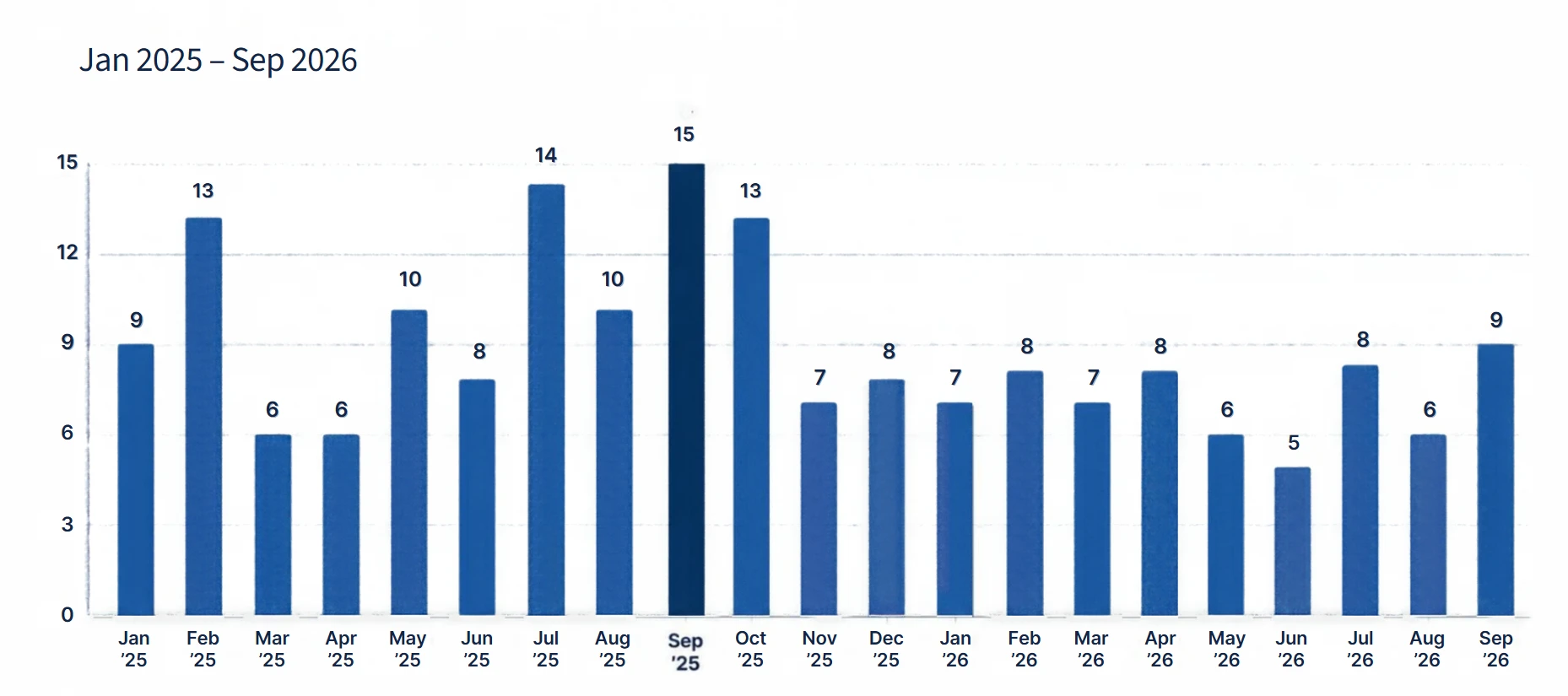
Meetings held per month
Source: internal AoS data
The work behind the numbers
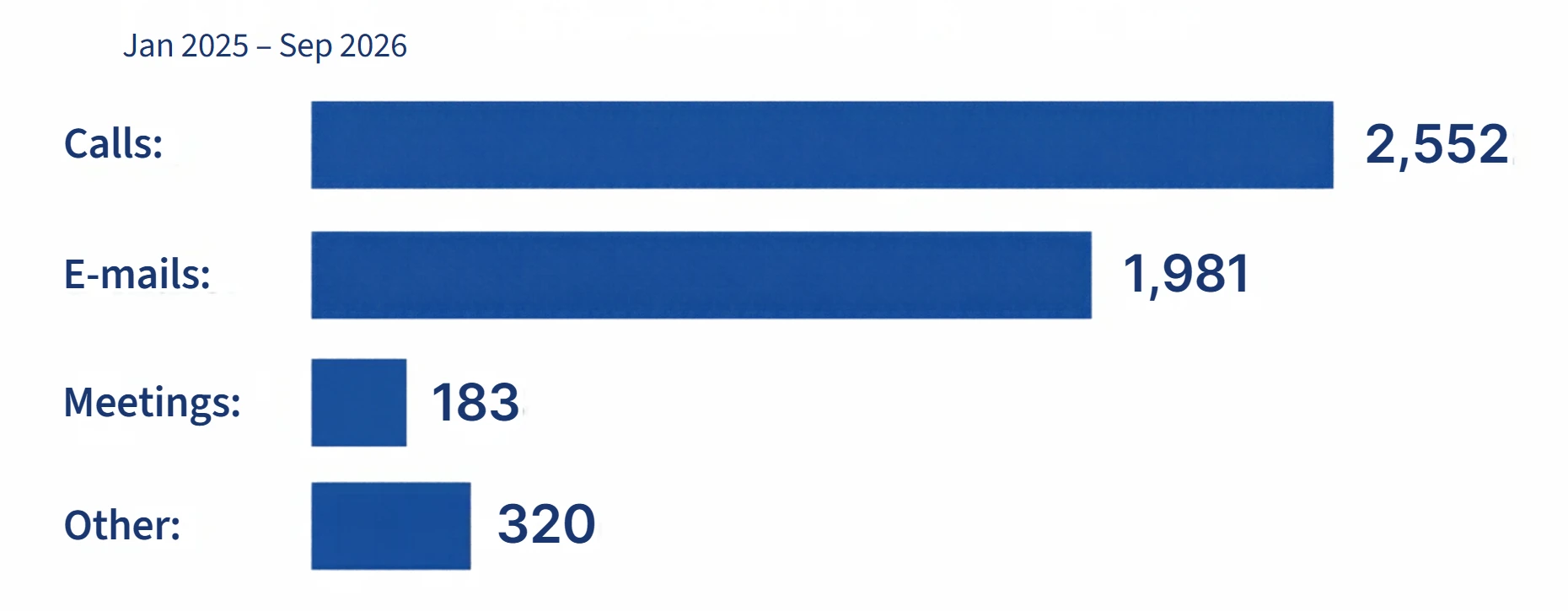
The numbers tell the story. Since January 2025, Michal has logged 5,037 activities across emails, calls, meetings, follow-ups, SMS and LinkedIn. That averages out to about 240 touchpoints every single month. At peak, in May 2025, he hit 335 activities in one month alone. This is what consistent, disciplined sales work looks like in a market that does not open its doors easily.
Across that effort, 425 deals entered the pipeline. 1,980 emails sent. 2,552 calls made. 183 meetings held. Each one a real conversation with a decision-maker in Polish commercial real estate.
Activity breakdown
Source: internal AoS data
The results reflect that work. 62 clients are past the second meeting. 18 are in active negotiations. 2 are ready for a pilot, currently being processed. 10 proofs of concept have been run in total, across properties of multiple investors, each one proof that Exergio’s platform works in the Polish market. On top of that, 3 commercial agreements have been signed, including one with a major investor carrying significant roll-out potential across their entire portfolio. A partnership with one of the most influential companies in the Polish commercial real estate market is in the final stage of closing, and it will boost the numbers and speed up the decision-making process.
That is not just a pipeline. That is a market entry. Built from scratch, one conversation at a time.
And we accomplished all of this within a budget of just 50 hours per month.
What we learned
Selling something free still requires sales skills. Clients don’t just weigh financial risk. They weigh time investment, implementation complexity, and what comes after the pilot. They are already thinking about commercial terms before the pilot starts.
The best founders to work with are those who treat outsourced sales as a partnership, being ready for honest conversations, process optimization, and joint problem-solving when things stall. If a founder just wants to hand off responsibility for success, it won’t work.
Exergio understood that. And that partnership is what made this market entry possible.
Here’s a bonus video conversation with Michal about entering the Polish commercial real estate market:

Dominik Wantuch
I am dedicated to facilitating your entry into the Polish market. At Architecture of Sales, my team and I are committed to enhancing your visibility and boosting sales in Poland through the following strategies:
Market Validation Activities - We conduct comprehensive market research, analysis, SWOT assessments, competitor evaluations, and direct customer interviews to validate your market approach.
Lead Generation - Utilizing both outbound and inbound methods, including various Sales Development Representative (SDR) prospecting techniques, we generate high-quality leads to drive your sales pipeline.
Sales and Marketing Support - Acting as your local sales and marketing department, we adeptly represent your brand to customers, providing comprehensive support to strengthen your market position.
Business Partner Identification - Whether identifying a local partner or developing an effective affiliate program, we assist in establishing valuable collaborations to optimize your market presence.
While our primary focus is on B2B SaaS companies, we are also open to collaborating with hardware-selling enterprises. For instance, we have successfully sold SaaS solutions, including ERP systems, to diverse sectors such as manufacturing, construction, retail, IT, HR, and EHS management.
Newsletter
Subscribe for more
Subscribe to our newsletter to get unique insights into the Polish market.
No strings attached, you can unsubscribe anytime. For more details, review our Privacy Policy.