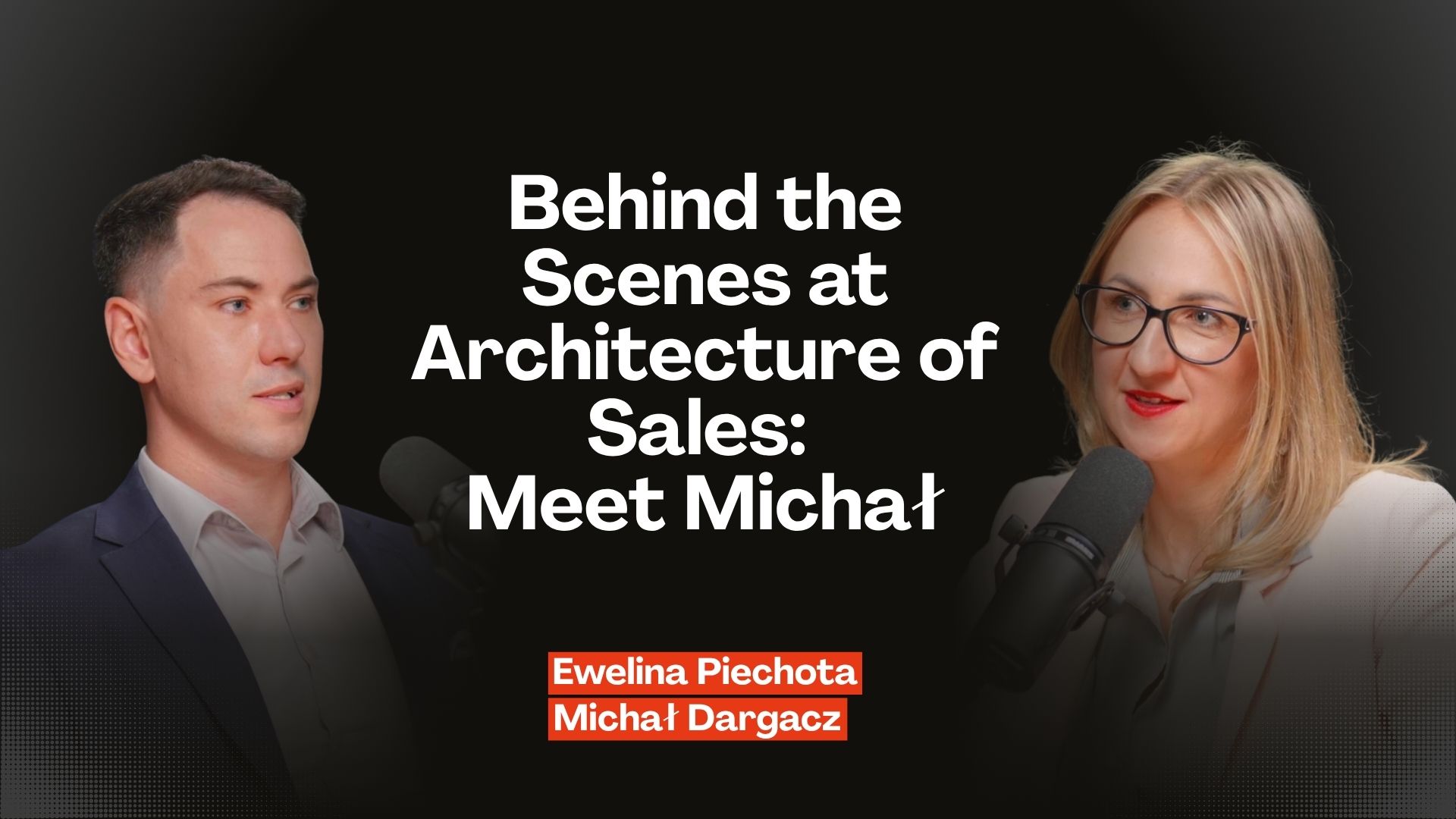
This article is based on our video interview with Michał. Watch the full conversation in Polish here.
At Architecture of Sales, we help foreign companies break into the Polish market — and behind that, there’s a team figuring out, project by project, what actually works. We sat down with Michał Dargacz, one of our team members, to talk about how he got here, what surprised him in his first months, and what he’s learned since.
An unlikely path into sales
Michał’s road to B2B sales didn’t start in sales at all. The bulk of his early career was in hospitality — mostly five-star hotels, in Poland and abroad. At some point, he decided to make the switch.
Before joining Architecture of Sales, he spent two years at a company handling technical servicing for commercial real estate. That’s where he first got serious about a different way of selling — one built on value and on genuinely understanding a client’s pain points, rather than pushing a product. It’s an approach, he notes, that’s still surprisingly rare on the Polish market.
It’s a background that, on paper, looks like a detour. In practice, it turned out to be exactly the right preparation.
“The hospitality side gave me a high level of empathy — the ability to read between the lines, pick up on nuance, and actually draw the right conclusions from a conversation,” he explains. The real estate role, meanwhile, gave him his first real exposure to B2B sales, a taste of B2G and tender work, and — on one current project in particular — technical knowledge of commercial real estate that turns out to be directly useful.
The first month: more freedom than expected
Ask most new hires what surprised them in their first weeks, and you’ll hear some version of “there was more to learn than I expected.” Michał’s answer was different: what struck him was the sheer level of responsibility and independence handed over right from the start.
“There’s a lot of room here to work independently from day one,” he says. “The outcome is what ultimately matters, but there’s no well-worn path telling you exactly how to get there. We have real influence over how we get to a result.” His conclusion: if you’re someone who’s genuinely self-driven and values autonomy, you’ll do well in this kind of environment.
That freedom came with a learning curve. He didn’t fully know what he was signing up for when he applied — the job posting, written by Dominik, had an interesting concept behind it, and Michał was mainly looking for room to grow. What he found exceeded that. As he puts it, a job listing can only say so much; explaining what the role actually involves — what the team does day to day, how, and with what tools — really takes a longer conversation.
By his own estimate, it took about three months before he felt confident in the role, and around six months before he felt like he’d been doing it for two years.
The lesson that changed how he works
Every role has a moment where early instincts get corrected by experience. For Michał, it was about how much to take a client’s word at face value.
“Early on, I think I put almost blind faith in whatever the client told me — adjusting everything to match their view, even when reality might look quite different and probably called for a deeper conversation about whether their approach was actually the right one,” he says. In those first months, the work was naturally more execution-focused: without experience in project work, he focused on delivering what was expected, the way it was expected.
With more projects, more conversations, and more meetings behind him, that’s changed. Now he’s able to spot, earlier, when something won’t work — even if the client hasn’t considered it, often because of cultural differences or a lack of first-hand experience with the Polish market specifically. It’s a shift from executing instructions to actively shaping the approach.
What “understanding the client” actually looks like
That shift shows up clearly in how the team approaches new projects. During onboarding, the questions come thick and fast: What exactly does the client do? Who are they reaching? What’s the message? Why did past clients actually buy? What’s worked well in previous conversations?
From there, that information gets run through what Michał calls “a pretty thick filter” — the team’s own experience combined with the realities of the Polish market. Because whether anyone likes it or not, markets are different, and what works elsewhere doesn’t always translate directly.
A small team that actually leans on each other
Day to day, most of the team works fairly independently — everyone has their own projects, tasks, and meetings. But when it comes to staying sharp and learning from one another, Michał describes a team that leans in.
“We have a fairly strong team in terms of diversity — different people are better at different things. So we share that knowledge regularly. If someone’s stuck, whether it’s about communication, a specific tool, or understanding how a particular industry works, we support each other. There’s no issue with grabbing half an hour to talk something through and just help each other out.” He puts part of that down to still being a relatively small company, where every single person genuinely matters.
Learning modern sales — and where AI fits in
Before joining Architecture of Sales, Michał had read and listened to a lot about modern sales — with a shoutout to Szymon Negacz as an influence — but hadn’t had the chance to actually put it into practice. Modern selling, as he sees it, requires a genuinely unique product or service that brings real value compared to what’s already on the market; otherwise, you’re just competing on price.
What he wanted most was to learn modern prospecting using the full range of technology available on the market. By his own assessment, he’s about 90% of the way to that goal, with the remaining 10% simply reflecting how fast the landscape keeps moving. New variables, new tools, new things to learn — that part never really finishes.
A turning point, and advice for anyone considering the leap
Asked about his biggest professional success, Michał resists picking just one thing — he sees life as made up of many wins, not one defining moment. But if he had to point to something, it would be the decision to make this career change in the first place, and the fact that it worked out the way it did. Project wins, he says, are a different kind of victory — something he takes real satisfaction in, in their own way.
So what would he tell someone weighing whether to join?
“If you actually want to grow — not just get a fancier title or a bigger paycheck, because everyone wants that — but really learn new skills, do work that has real meaning instead of selling, as I’d put it, ‘the proverbial brick,’ and learn to work with technology that includes a serious amount of AI — the kind that genuinely pushes your skills forward — then this is the place for you.”
Interested in modern sales and want to grow in this space? Architecture of Sales is always expanding the team — check our current openings to see if there’s a fit for you.

Dominik Wantuch
I am dedicated to facilitating your entry into the Polish market. At Architecture of Sales, my team and I are committed to enhancing your visibility and boosting sales in Poland through the following strategies:
Market Validation Activities - We conduct comprehensive market research, analysis, SWOT assessments, competitor evaluations, and direct customer interviews to validate your market approach.
Lead Generation - Utilizing both outbound and inbound methods, including various Sales Development Representative (SDR) prospecting techniques, we generate high-quality leads to drive your sales pipeline.
Sales and Marketing Support - Acting as your local sales and marketing department, we adeptly represent your brand to customers, providing comprehensive support to strengthen your market position.
Business Partner Identification - Whether identifying a local partner or developing an effective affiliate program, we assist in establishing valuable collaborations to optimize your market presence.
While our primary focus is on B2B SaaS companies, we are also open to collaborating with hardware-selling enterprises. For instance, we have successfully sold SaaS solutions, including ERP systems, to diverse sectors such as manufacturing, construction, retail, IT, HR, and EHS management.
Newsletter
Subscribe for more
Subscribe to our newsletter to get unique insights into the Polish market.
No strings attached, you can unsubscribe anytime. For more details, review our Privacy Policy.